01
Civilisation
Rediscovering intellectual confidence — philosophy, history, religion, culture, language, identity, ethics and intellectual traditions. How can civilisations engage one another without domination?

The Global Reference for Ideas About the Future of Asia
Civilisation · Ideas · Leadership · Human Potential · The Asian Century
Asia is no longer simply rising.
It is becoming one of the principal centres of economic power, technological capability, demographic weight, cultural influence and geopolitical consequence in the world.
But economic scale alone does not constitute a renaissance.
A renaissance begins when a civilisation starts asking deeper questions about itself — what values should guide progress, what kind of economy should be built, how technology should serve humanity, what leadership should mean. And ultimately:
What kind of Asia should emerge?
The Big Idea
For much of the modern era, Asia was discussed through the language of colonisation, development, industrialisation and catching up. Then came the Asian economic miracle — Japan industrialised, the Asian Tigers emerged, China transformed into an economic superpower, India became one of the world's largest economies, and Southeast Asia one of its most dynamic regions.
But a century defined by Asian economic power is not necessarily a renaissance. A genuine renaissance must go beyond wealth.
It requires:
The question is no longer: Will Asia rise?
The larger question is: what will Asia do with its rise?
The book that envisioned the future of Asia
Anwar Ibrahim · 1996
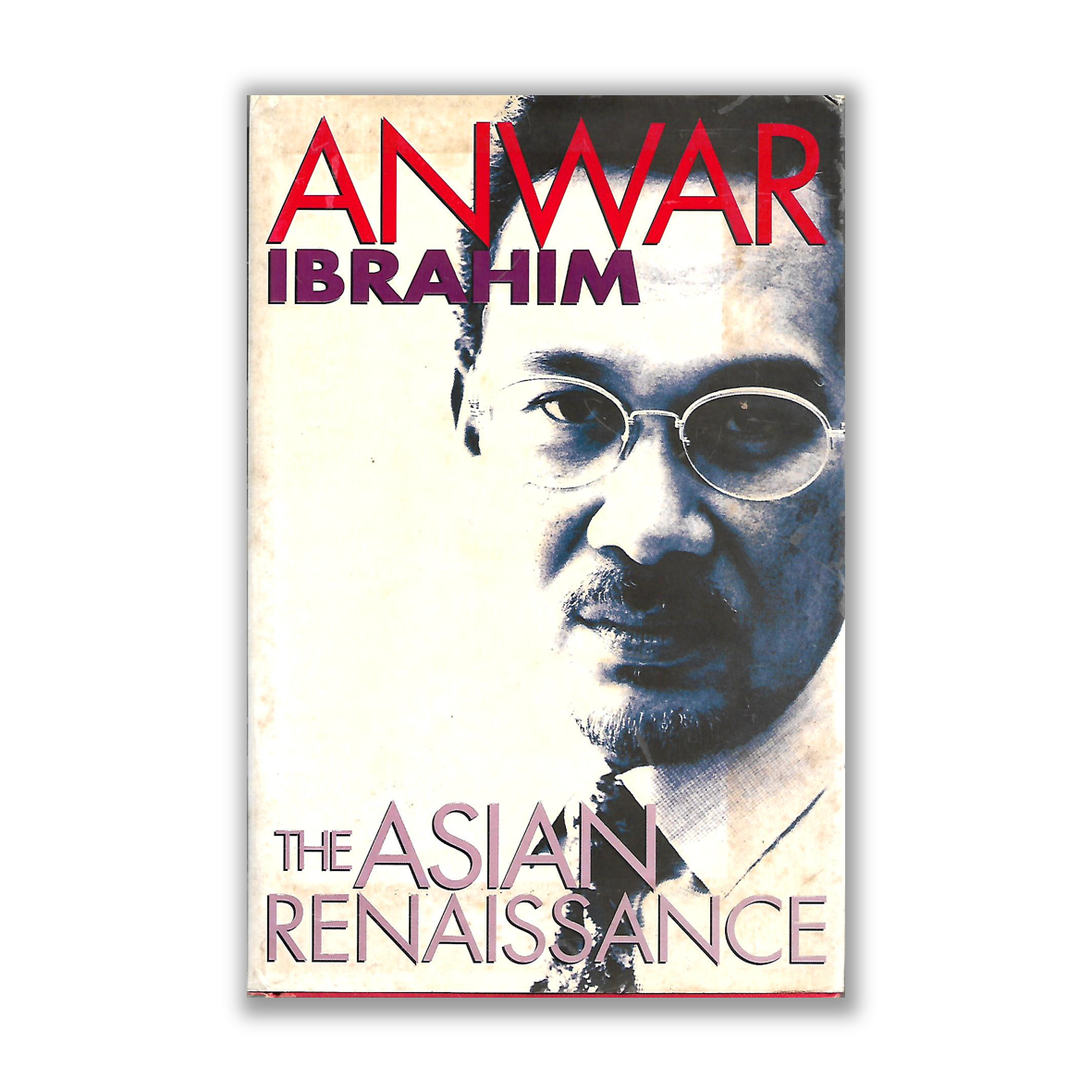
Published in 1996, The Asian Renaissance by Anwar Ibrahim emerged at a moment when Asia was experiencing extraordinary economic confidence and political self-assertion. The book was not simply a commentary on Asia's rapid development; it was a broader civilisational argument about what Asia's rise should ultimately mean. Anwar contended that material prosperity alone could not constitute a true renaissance. Economic progress had to be accompanied by intellectual renewal, ethical leadership, cultural vitality, justice, pluralism, democratic responsibility and respect for human dignity.
At the heart of the book is a rejection of the idea that Asia must choose between tradition and modernity. Anwar argued that Asian societies could modernise without abandoning their civilisational roots, and could engage Western ideas without becoming mere copies of the West. The task was not to retreat into cultural nostalgia, but to recover confidence in Asia's own intellectual traditions while remaining open to universal knowledge, dialogue and progress.
The book appeared during one of the most optimistic periods in modern Asian history. By the mid-1990s, Japan had long established itself as a major industrial power, the East Asian "Tiger economies" had become symbols of rapid development, China's economic transformation was accelerating, and Southeast Asia was experiencing strong growth and deeper regional integration. There was widespread discussion of an "Asian miracle" and growing speculation that the centre of global economic gravity was beginning to shift eastward.
This confidence also gave rise to an intense debate over "Asian values." Leaders and intellectuals across the region were questioning whether Western liberal political and social models were necessarily universal. Discussions centred on the role of community, family, social order, cultural identity, economic development and political authority. The Asian Renaissance entered this debate but sought to move beyond a simple East-versus-West binary. Its argument was less about defending a fixed set of "Asian values" and more about constructing a modern Asian civilisation rooted in moral confidence, intellectual openness and cultural self-awareness.
The wider international context was equally important. The Cold War had ended, the United States stood at the height of its global influence, and many commentators believed Western liberal democracy and market capitalism had become the dominant model of modernity. Against this backdrop, The Asian Renaissance posed a different possibility: that Asia could participate fully in modernity while also contributing its own civilisational resources, philosophical traditions and historical experiences to the global conversation.
The timing of the book was also striking because it came just before the 1997 Asian Financial Crisis, which shattered much of the region's economic triumphalism. In retrospect, this made one of the book's central insights even more significant: economic growth alone is fragile if it is not accompanied by sound institutions, ethical leadership, social cohesion and a deeper conception of human development.
Thirty years later, The Asian Renaissance can be read both as a product of the optimism of the 1990s and as an unfinished intellectual project. Asia has since become far more powerful economically, technologically and geopolitically than it was in 1996. Yet the fundamental question posed by the book remains unresolved:
What kind of civilisation should Asia become as its power and influence continue to grow?
That is why the book remains relevant today. Its enduring contribution lies not merely in anticipating Asia's rise, but in insisting that the meaning of that rise must ultimately be judged by the quality of the civilisation it creates.
From 1996 to the Next Renaissance
The internet was still emerging. China had not yet become the power it is today. AI had not entered everyday life. Social media did not exist. Climate change had not acquired its present urgency. Three decades later, Asia faces a new generation of questions.
1996
Today
The original Asian Renaissance conversation needs to be continued. Not repeated. Extended.
Our Mission
Asian Renaissance brings together thinkers, historians, economists, scientists, entrepreneurs, policymakers, artists, technologists, educators, writers, community leaders and emerging voices to explore the forces shaping Asia's future — to become the most trusted and consequential platform for serious thinking about Asia.
The intellectual map of Asia.
The library of Asia's ideas.
The forum for Asia's great debates.
The observatory for Asia's transformation.
The network for Asia's future thinkers.
Asia Is a Civilisation of Civilisations
Asia cannot be reduced to a single identity. It contains some of the oldest and most influential intellectual and civilisational traditions in human history. Its diversity is not an obstacle to creating an Asian consciousness — it is the foundation of it. Asian Renaissance imagines Asia as an intellectual commons where many traditions encounter one another.
From Asian Values to Asian Possibilities
The debate about Asian values raised important questions about community, rights, responsibility, authority, family, culture, development and democracy. But Asia has moved into a different historical moment. The more ambitious question is no longer whether Asian values differ from Western values — it is: what new possibilities can Asia contribute to humanity?
From Asian Values
To Asian Possibilities
From defending difference
To creating alternatives
From identity
To imagination
From catching up
To thinking ahead
The Asian Renaissance Framework
Rediscovering intellectual confidence — philosophy, history, religion, culture, language, identity, ethics and intellectual traditions. How can civilisations engage one another without domination?
Human potential as the centre of development. The next Asian miracle may be a Human Potential Miracle — people as creators, contributors, citizens, innovators and fully realised human beings.
What comes after the Asian economic miracle? From labour to talent, manufacturing to innovation, GDP to multidimensional prosperity, growth to human flourishing.
The Asian age of intelligence. What should intelligence be for? Can AI expand human agency rather than diminish it? Can Asia articulate a philosophy of human–AI civilisation?
Rebuilding community in the network age — community economies, social capital, cooperatives, participatory governance and civic innovation. The future may belong to stronger communities.
Beyond East versus West. Asian societies are experimenting with democracy, meritocracy, state capacity, participation, digital governance and institutional competence — without ideological simplification.
Prosperity within planetary limits. How can Asia develop without undermining the ecological foundations of civilisation?
Asia and the emerging global order. Not replacing Western dominance with Asian dominance — but a genuinely multipolar world where civilisations contribute ideas, institutions and leadership.
Ten Shifts
Ideas
Essays, conversations, research and analysis across the defining questions facing the continent.
How is economic and geopolitical power shifting?
What intellectual traditions continue to shape contemporary Asia?
Can Asia develop different models of modern civilisation?
What comes after industrial capitalism?
How should societies identify and develop talent?
How will AI, automation and independent work reshape employment?
How should Asia govern intelligent technologies?
Can community become a central institution of future societies?
What political and institutional models are emerging across Asia?
How will China, India, ASEAN, Japan, Korea and other powers shape the global order?
Can Asia create a new model of ecological prosperity?
How is Asian creativity influencing global civilisation?
Thinkers
The intellectual map of the people who shaped how Asia understands itself.
…and emerging thinkers across Asia.
The Asian Canon
A living library spanning civilisation, philosophy, history, politics, economics, religion, development, culture, geopolitics, technology, society and futures.
The Asian Renaissance
Anwar Ibrahim
From the Ruins of Empire
Pankaj Mishra
The Argumentative Indian
Amartya Sen
The New Asian Hemisphere
Kishore Mahbubani
The Future Is Asian
Parag Khanna
How Asia Works
Joe Studwell
Provincializing Europe
Dipesh Chakrabarty
The Reconstruction of Religious Thought in Islam
Muhammad Iqbal
The Discovery of India
Jawaharlal Nehru
The Ideals of the East
Okakura Kakuzō
Asian Futures
Artificial intelligence becomes deeply integrated into economies and institutions.
Asian economies become increasingly interconnected through infrastructure, capital, technology and talent.
Asia becomes one of the principal centres shaping global civilisation.
We explore futures involving AI, demography, cities, education, work, migration, energy, food, climate, culture, health, trade and geopolitics. Futures are not predictions — they are tools for imagination.
Asian Renaissance Index
GDP tells us how large economies become — not the quality of the societies they create. The ambition: measure not only how much Asia grows, but how well Asia develops.
Human Potential
Knowledge
Innovation
Creativity
Institutional Quality
Social Trust
Community Strength
Sustainability
Cultural Vitality
Quality of Life
Technological Capability
Global Contribution
Asian Renaissance 100
An annual recognition of individuals making significant intellectual and civilisational contributions to Asia. Not a ranking of wealth or fame — it recognises contribution.
Asian Renaissance Review
Arguments that challenge conventional assumptions.
Conversations across civilisations and disciplines.
Profiles of influential Asian intellectuals.
Reviews and discussions of major works.
Rediscovering forgotten intellectual movements.
Scenarios and emerging signals.
Visual intelligence about Asia's transformation.
Great Questions
Programmes
An annual marketplace of ideas about Asia's future — thinkers, scientists, entrepreneurs, artists, policymakers and young thinkers. Possible host cities: Kuala Lumpur, Jakarta, Singapore, Bangkok, Seoul, Tokyo, Delhi, Beijing, Istanbul.
Identifying emerging writers, researchers, entrepreneurs, designers, scientists, policy thinkers, artists, educators and community builders — a trans-Asian network of future intellectual leadership.
Turning ideas into experiments: human potential, future education, future of work, AI & society, future communities, governance innovation, sustainability. Ideas → experiments → evidence → scalable models.
Seeing Asia through data — population, growth, trade, technology, talent, education, inequality, climate and geopolitics. Flagship: Asia in 100 Charts, a continuously evolving visual portrait of Asia.
Mapping the intellectual geography of Asia — thinkers, universities, civilisations, cities, research centres, books and ideas. The Silk Roads moved more than goods; they moved ideas, religions, languages and knowledge.
Manifesto
Asia's greatest resource is ultimately not its population, territory, capital or technology. It is Human Potential.
The Human Renaissance
Industrial societies designed people around institutions: schools prepared people for jobs, companies organised people into hierarchies, economies measured people through productivity. The emerging age creates another possibility — institutions designed around human potential.
Education can become personalised. Work can become networked. Talent can become visible. Communities can become platforms for collaboration. AI can augment individual capability. The next Asian miracle may not be primarily industrial — it may be the liberation of human potential at unprecedented scale.
From Asia rising to Asia contributing: the objective is not to prove Asia is superior, but to create ideas useful to humanity. The strongest civilisation is not the one that dominates others — it is the one capable of contributing beyond itself.
The twentieth century asked: Can Asia become modern?
The early twenty-first century asked: Can Asia become powerful?
The next era must ask: can Asia become consequential in ideas?
Join the Renaissance
It will emerge through millions of acts of thinking, creating, questioning, experimenting, collaborating and building. Students, thinkers, researchers, entrepreneurs, artists, policymakers, scientists, technologists, community builders and citizens — all are invited.
Read. Think. Debate. Imagine. Connect. Build. Shape the future of Asia.